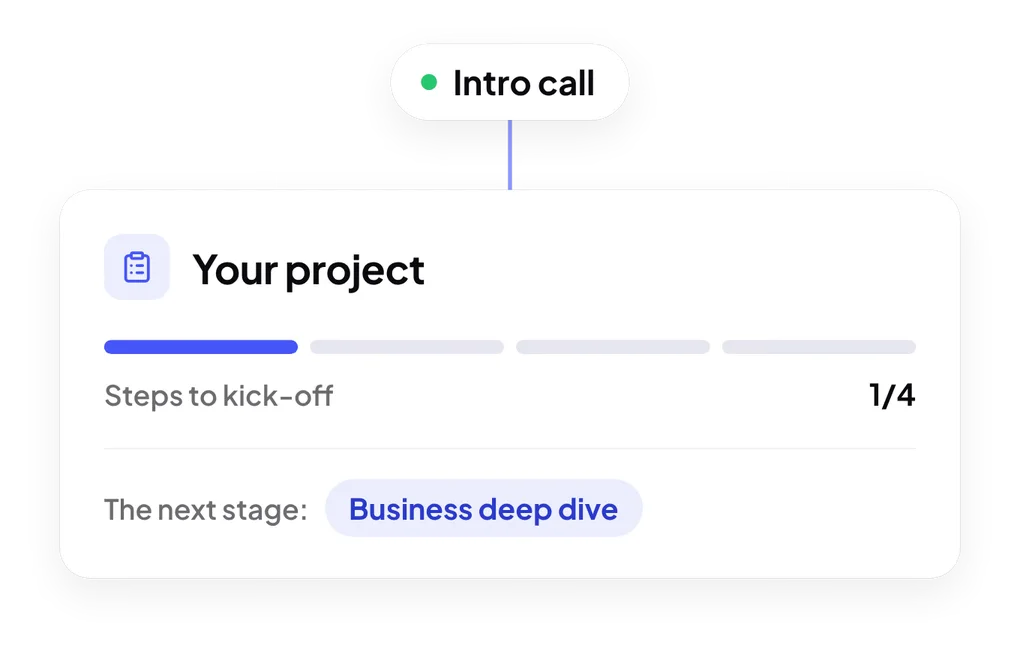
Faster delivery, same definition of done.
Engineers work with AI coding agents on every ticket from the first day of your project. Your backlog moves faster, and the bar for "done" stays where it was.
AI raises output. Our process keeps it safe to ship. Every LNOKS engineer builds with Claude Code agents, and every change is reviewed by a second engineer, backed by a test that fails without it, and checked by QA on dev, stage and production.
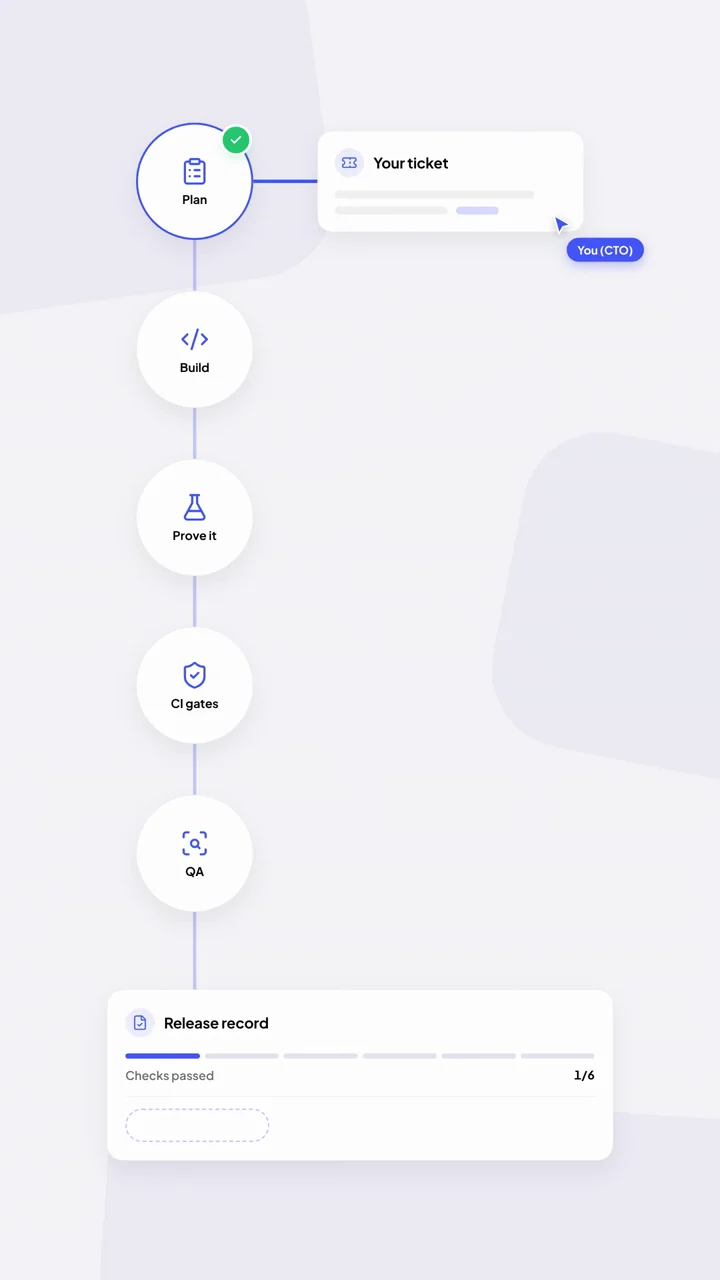
AI made writing code cheap. Proving that the code works is now the slow part, and LNOKS built its delivery around that. LNOKS is an AI-first software development agency: since 2025, every engineer has shipped with Claude Code agents and a skills library we add to on every project. Every change is then reviewed by a second engineer, backed by a test that fails without it, and checked by QA on dev, stage and production. For an AI SaaS platform, that meant 6.5× more delivered work per engineer than the previous vendor, 10× more automated tests and 3× faster CI, with the same definition of done.
Results
An AI SaaS platform, June to September 2026, compared with the vendor before us.
6.5 ×
more delivered work per engineer than the previous vendor
4 ×
more delivered in total, with a team about 40% smaller
10 ×
more automated tests than when we took over
3 ×
faster backend CI
Team: full-stack engineer, mobile engineer, manual QA engineer, automation QA engineer and tech lead. Delivered work is counted as merged pull requests.
Our Position
We use AI in every part of our workflow, and we expected it to cut the time we spend on review and testing. It did the opposite. More code arrives, faster, and checking it becomes the slow part. AI-generated code also fails in its own ways: tests that pass without checking anything, edge cases nobody asked about, and tickets marked fixed that still aren't.
So we kept every check and rebuilt them for the extra volume. A second engineer reviews every pull request. Every change has to come with a test that fails without it. CI rejects tests that mock the code they are meant to test, or that quietly weaken an assertion. QA runs on dev, stage and production. On our latest project, the automated test suite grew 10× while each engineer shipped 6.5× more.
Tests that pass without checking anything
Caught by the CI test-quality gate
Edge cases nobody asked about
Caught by the spec interview
Tickets marked fixed that still aren't
Caught by the QA re-check on production
Delivery Process
Twelve steps. Each one is tagged with who does the work: AI-assisted, automated, a human gate, or you.
An AI agent interviews your product owner until the open questions are closed. The result is a written spec. No code yet.
A clickable prototype built from your product's real UI components, approved before anyone writes code.
An implementation plan with a checkpoint for how each part will be verified.
The engineer works with AI coding agents, several in parallel where the work allows.
The engineer shows a test failing without the change and passing with it. A mutation check then changes the new logic on purpose to confirm a test catches it.
Type-check, tests, a coverage floor and an API-contract check. Every scenario in the spec must point to a real test. Tests that mock what they test, or weaken an assertion, are rejected.
A different AI model reviews the change and looks for ways it can break.
A second engineer reviews the code. Nobody merges their own work unchecked.
A QA engineer checks the change on the dev environment before it moves to stage.
Smoke suite on every stage deploy, full suite every night.
Written from the merge history: what changed, what to sanity-test, risks, how to roll back.
A ticket counts as fixed once the original problem is re-checked on production. Deploying the code isn't enough.
Why AI-First
Engineers work with AI coding agents on every ticket from the first day of your project. Your backlog moves faster, and the bar for "done" stays where it was.
We keep a library of reusable skills and agents for brainstorming, planning with verification checkpoints and parallel work. Your project starts with what we learned on the projects before yours. It also gets its own knowledge base: decisions, user flows and conventions written down as the work happens, so the AI and your next engineer start with the full context.
Type-checks, tests that must fail without the fix, AI review, a second engineer's review before merge, then QA on dev, stage and production. More code means more to check, so we check more.
Sprint planning, ticket grooming, technical design, status reports, and a release record for every release. You get clearer updates more often and spend less time in meetings.
Working With Us
Transparency
The AI workspaces we work in can sit in your accounts instead of ours.
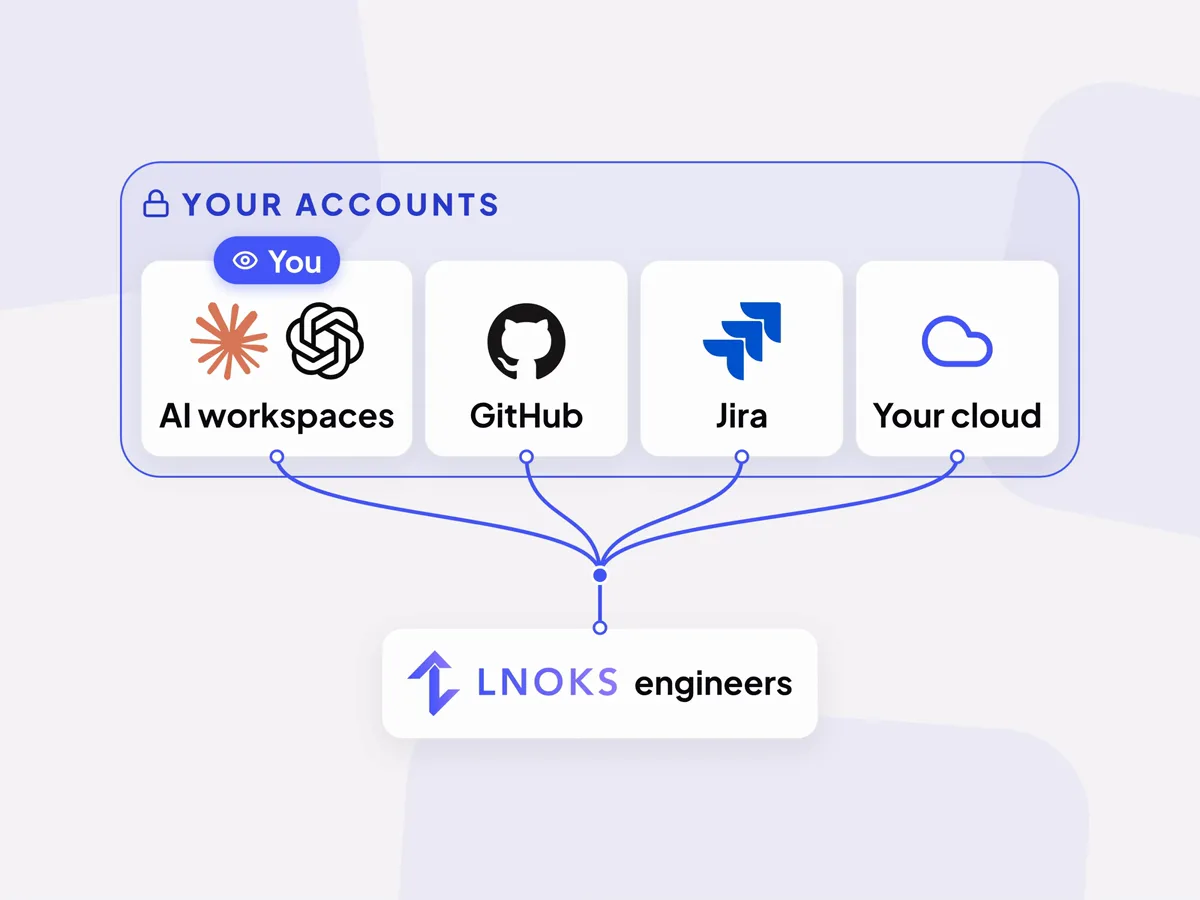
Usage per engineer, straight from the provider, with no markup on AI costs.
Prompts, workspace history and audit logs stay with you if the engagement ends.
The skills, rules and project knowledge base live as files in your repositories. If the engagement ends, the whole setup stays with you.
AI subscriptions are agreed up front as a line in the engagement.
Trust
By default we work in business-tier AI workspaces, where providers don't train on customer content. If a workspace isn't on a business plan, we check that training is switched off before we write any code.
We work inside your cloud accounts and your regions.
Secrets live in your cloud and CI secret stores, never in the repository or a prompt. Agents get only the access a task needs, and production changes go through a human.
AI suggests changes; a person is accountable for them.
That includes everything produced with AI assistance.
Pricing
We work on a monthly subscription rather than hourly billing. AI changes what that subscription gets you:
Features reach production sooner, so you release and learn earlier.
One small team works several branches in parallel instead of one at a time.
A scope that used to need four to six people, on the project below.
See the project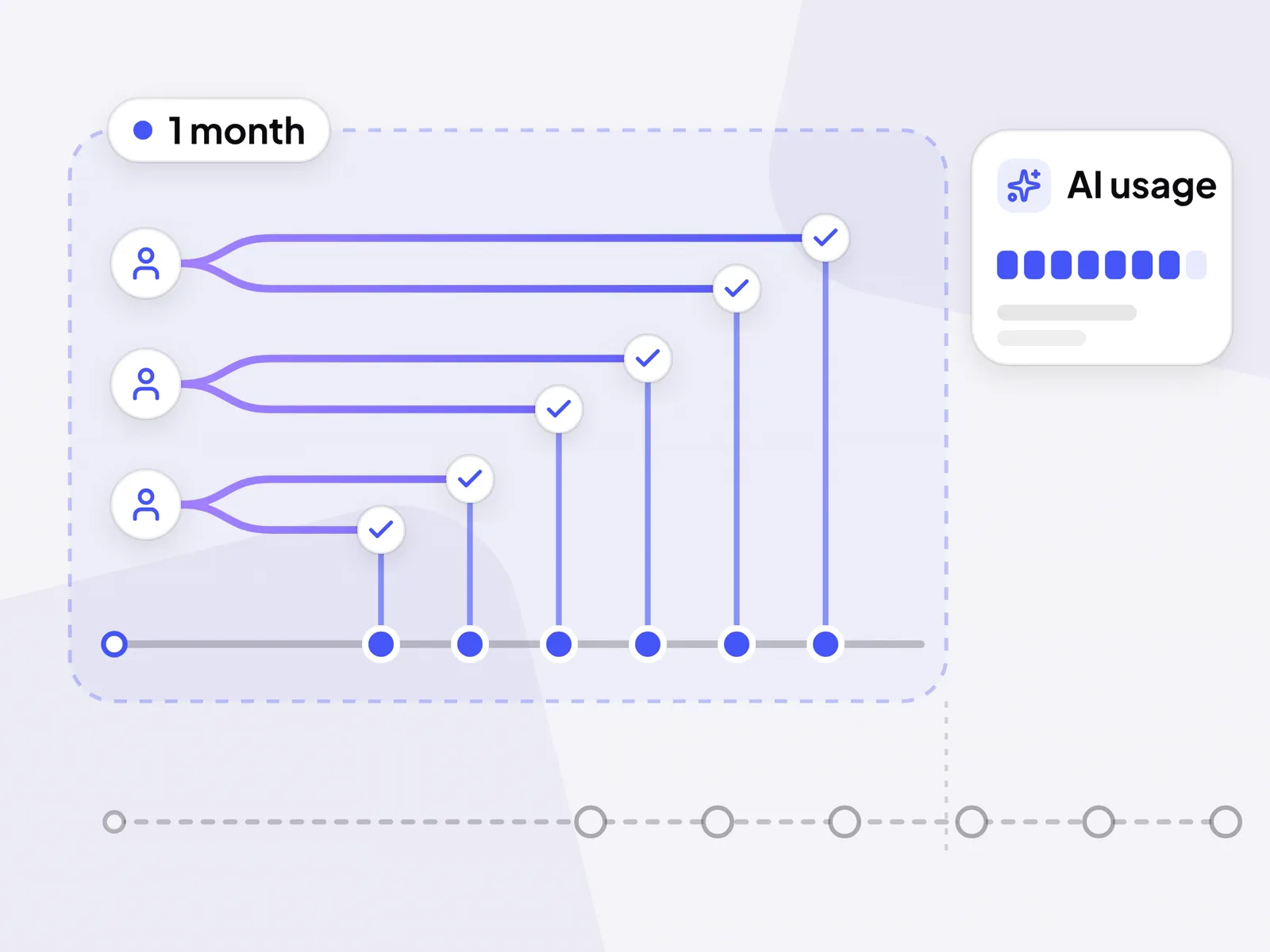
Case Study
Five LNOKS people (full-stack, mobile, manual QA, automation QA, tech lead), June to September 2026.
Before and after LNOKS joined
Also shipped

Max
Mobile engineer
"One to two hours of planning with Claude before every task."

Denys
Full-stack engineer
"I read every line Claude writes before it goes near tenant data."

Alex
Automation QA engineer
"Claude writes the test code, and I choose which bugs it has to catch."
Before you enquire
An AI-first software development agency builds software with AI tools at the centre of its workflow rather than as an add-on. At LNOKS, every engineer works with AI coding agents by default, and AI supports planning, coding, code review, testing and reporting. Engineers still own every decision and every merge.
AI-written code is safe for production when it has to prove itself before it merges. At LNOKS, every change comes with a test that fails without it, passes CI test-quality gates and an AI review, is reviewed by a second engineer, and goes through QA on dev, stage and production before release.
AI makes software development faster and lets a smaller team cover the same scope. LNOKS works on a subscription: AI shortens time to market, and a scope that once needed four to six people can be run by a smaller team working several branches in parallel. Part of the saving goes into extra checks, because more code needs more review.
The client owns all code, including code written with AI assistance. Every LNOKS client can hold the AI workspaces we work in under their own accounts, so they see the AI spend directly and keep prompts, history and audit logs if the engagement ends. The skills, rules and project knowledge base live as files in the client's repositories, so they stay with the client too.
No. By default LNOKS works in business-tier AI workspaces, where providers don't use customer content for training. If a workspace isn't on a business plan, we check that training is switched off before any work starts.
Copilot completes code inside an editor. LNOKS runs AI across the whole delivery process: agentic development in Claude Code, a reusable library of skills and agents, tests that must fail without the fix, AI review on every pull request, and AI-assisted planning and reporting. All of it sits inside a review and QA process built for higher output.
Yes. On the project above, we worked entirely inside the client's Claude workspace, Jira and GitHub. Our skills, rules and knowledge base live as files in your repositories, so they stay with you. The one thing we check first is the plan: training on your code must be switched off.
On a recent project for an AI SaaS platform, a five-person LNOKS team delivered 6.5× more work per engineer than the previous vendor, and 4× more in total with a team about 40% smaller. In the same three months the automated test suite grew 10× and backend CI became 3× faster.
In 30 minutes, our Tech Lead takes a real ticket from plan to pull request, live, and walks you through every check that comes after.