Custom business software
Custom business software for the work your tools cannot handle.
For owner-led businesses whose important work still runs on spreadsheets, paper or chat.

Custom business software is software built around how one company runs its work: stock and orders across locations, projects and materials, role-based workflows and internal portals. LNOKS builds it for owner-led businesses of 10 to 200 people that have outgrown spreadsheets and generic tools, and keeps developing it after launch. For ToBeModern, a furniture manufacturer, we replaced paper notes with a project dashboard and materials tracking per project, and we have kept developing it since 2022. For qLoota, consultants serving manufacturers in Finland, we built resource management with QR scanning, dispatching and access control. A project starts with a call and a first release scoped around one workflow.
Is this you?
Signs this is the right service.
- 01
Stock, orders or projects are tracked in spreadsheets that no longer match reality.
- 02
Each location or team keeps its own version of the same information.
- 03
A general-purpose tool was tried and the team went back to paper or chat.
- 04
Managers can only learn the status of work by asking someone.
Scope
Examples of what we build
01
Stock and order visibility
One shared record of stock and orders across shops, warehouses and channels.
02
Project and materials tracking
Projects broken into items, materials and deadlines, with status visible to the people who need it.
03
Role-based workflows
Each role sees its own tasks and actions, from floor staff to head office.
04
Internal portals
A single place for teams, partners or clients to find records, documents and status.
How a project starts
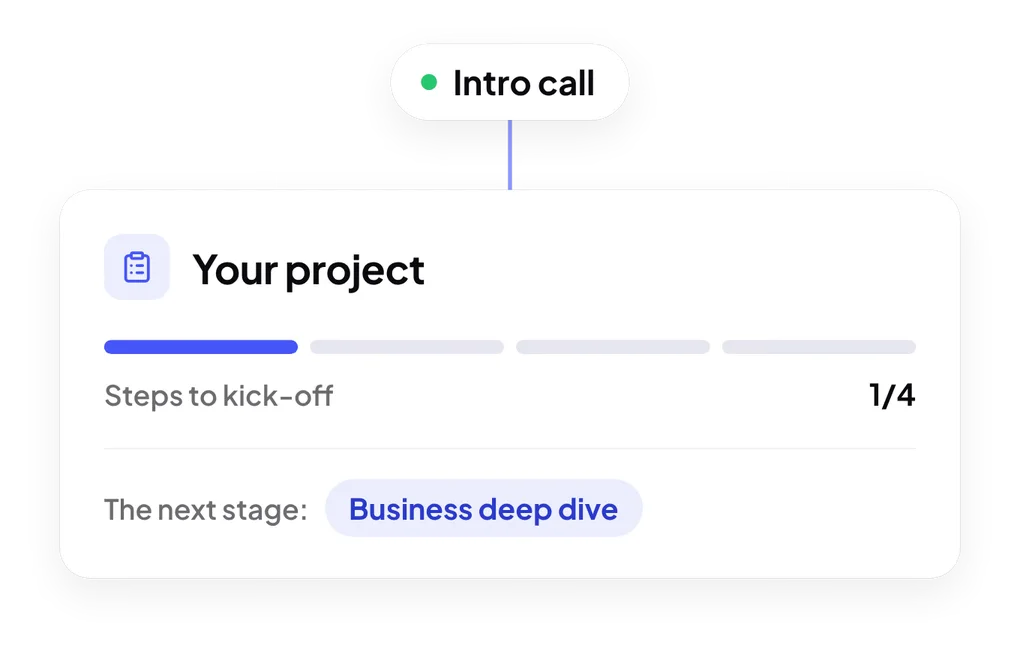
Start with a conversation about the problem.
We first want to understand what is happening today. What follows depends on how clear the work already is.
-
A conversation about the problem
We start by understanding what happens today: how the work runs, which systems are involved and where it breaks.
-
An assessment, if the scope is uncertain
When several systems, unclear data or an undocumented process are involved, a short assessment maps the process, the risks and the options first.
-
A focused first release
When the workflow and systems are already clear, we agree a first result with acceptance criteria and start building it.
-
Ongoing support
After launch, we agree who fixes what, in which hours and how fast we respond.
Why custom
When a custom build is justified
Custom software is worth building when most of these are true:
- The process is specific to how you work and important to the business.
- Existing tools have been tried or assessed and need constant workarounds.
- Several roles need to work on the same records with different permissions.
- You expect the process to change and want a system you can keep adapting.
If an existing tool can reasonably handle the work, we will say so and look at connecting it instead.
The first result
Define a useful first release
The first release replaces one workaround for one team or process, so it is used from the start. Further features are added from what people need in daily use, the way ToBeModern’s platform grew from core project and materials tracking.
-
-
A project list with items, materials and deadlines for the production team.
-
Scanning items in and out of a warehouse instead of updating a spreadsheet.
The first release is agreed with you during scoping.
Proof
Work we have delivered.
Projects where we delivered this kind of work.
-

Inventory management platform for a German retail group
A custom inventory management platform that brings stock, shops, orders, customers, suppliers and assets into one system across a German retailer’s locations.
-

Project and materials management for a furniture manufacturer
Software for a furniture manufacturer’s project, materials and status workflows, replacing paper notes and verbal instructions.
-

Custom warehouse management system for multi-location operations
A custom WMS that moved inventory tracking off spreadsheets across multiple warehouses in California, with QR scanning, one view of stock and order management.
-

Resource tracking and QR dispatch for a Finnish manufacturing consultant and his clients
A web platform that helps manufacturing operations consultants and their clients manage resources and dispatch items with QR codes, in place of several separate tools.
Expertise
The expertise behind this service.
Capabilities we use across services, with the projects that show them.
Inventory and order management
Stock, orders and warehouses in one place: one live stock record for every shop and warehouse, so orders, transfers and dispatch work from the same numbers.
Shown in
German retail group · qLoota · Vernox
Operations systems
One system for your projects, orders and approvals, built around how your team already works, so deadlines, materials and sign-offs stop living in notes.
Shown in
ToBeModern · EZBuild
Relevant services
Services often combined with this one.


Building a product for your customers? Explore our product development services
Before you enquire
Questions about custom business software.
Custom business software is built around how one company runs a process, instead of making the team adapt to a general-purpose tool. ToBeModern evaluated ClickUp and found it too complex for its production staff, so we built a system that follows how the workshop already works: projects, then items, then materials.
Yes. If an existing tool can reasonably handle the work, we say so and look at connecting it instead. A custom build is worth it when the process is specific to how you work, existing tools need constant workarounds, and several roles work on the same records.
It depends on the workflow, and the estimate states the timeline before any build starts. On past projects, first releases have taken about three months from kickoff, including Vernox in California and qLoota in Finland. We keep the first release to what one team needs, so it is in use from the start.
Yes. Role-based access is part of most systems we build. qLoota has three access levels, for the consultant, the plant manager and the floor operator, and ToBeModern’s platform is used by the owner, managers and production staff, each with their own view.
Yes. Further features are added from what people need in daily use. We have kept developing ToBeModern’s project and materials platform since 2022, growing it from the core project and materials tracking.
Your company owns the code and the accounts. The software can run on your own server: ToBeModern’s platform, built with React, NestJS and PostgreSQL, runs on the customer’s server.
A project starts with a call. We then scope a first release around one workflow and agree it with you before building, so you know what the first version will replace.
Tell us about the workflow you want to change.
On the first call we clarify the problem, what you already run and a sensible next step.